
Many growing brands struggle to juggle FDA labeling requirements while simultaneously choosing between pouches, trays, cartons, and cans. It's a lot to manage at once, especially without a regulatory or packaging background.
This guide breaks down ingredient labeling rules, the seven major food packaging categories, and how to find a packaging partner who won't leave you guessing.
Key Takeaways
- FDA rules set placement, order, and format for ingredients, allergens, and manufacturer details
- Match each product to one of seven packaging categories based on shelf-life needs
- Material choice sets moisture and oxygen barriers—and your realistic shelf life
- An integrated packaging partner cuts lead times and compliance risk
What Are the FDA Ingredient List Requirements?
Panel Placement and Ingredient Order
Ingredient statements must appear on the Principal Display Panel (PDP) or the Information Panel, the area immediately to the right of the PDP. Under 21 CFR 101.2, this required information should stay together on one panel, without other text breaking it up.
Ingredients must be listed by their common names in descending order by weight. A few rules to know:
- Ingredients at 2% or less by weight can go at the end, following a statement like "Contains 2 percent or less of..."
- Compound ingredients (such as a seasoning blend): use the common name with sub-ingredients in parentheses, or list each component in the finished product's weight order
Allergen Declarations
FALCPA requires major allergens to be clearly declared. FDA recognizes nine: milk, eggs, fish, crustacean shellfish, tree nuts, peanuts, wheat, soybeans, and sesame (added in 2023 under the FASTER Act).
You have two options for declaring these:
- Parenthetically: right after the ingredient, like "lecithin (soy)"
- In a Contains statement: immediately following the ingredient list, like "Contains wheat, milk, and soy"

What Else Belongs on the Label
Beyond ingredients and allergens, your label needs:
- Manufacturer/packer/distributor name and address: the actual business name, qualified with "Manufactured for" or "Distributed by" if applicable
- Net quantity statement: typically in the bottom 30% of the PDP
- Nutrition Facts Label: following FDA's updated format, which includes Added Sugars and removed Calories from Fat
For the full regulatory text, the FDA Food Labeling Guide is a helpful starting point, though it's nonbinding, so always cross-check with the current eCFR.
Common Mistakes That Trigger Recalls
FDA has taken action against brands for both under- and over-declaring allergens. Warning letters have cited labels that listed sesame that wasn't in the product and omitted nuts that were. Allergen-related recalls also show up often in deli and bakery items when allergen declarations are missing entirely.
The lesson: reconcile your formula, ingredient specs, and label artwork every single time something changes.
What Are the 7 Types of Food Packaging?
Packaging format directly shapes shelf life, cost, and shelf presence. Here's how the main categories break down.
| Category | Best For | Key Consideration |
|---|---|---|
| Flexible packaging | Snacks, sauces, powders, coffee | Layered films can separate print, barrier, and heat-sealing functions |
| Rigid/thermoformed plastics | Fresh meat, produce, prepared meals | Test the tray, lid, and seal together, not the film alone |
| Shrink sleeves & labels | Bottles, cans, irregular shapes | Confirm legibility and recycling compatibility, not just decoration |
| Paperboard cartons | Cereal, frozen foods, dry goods | Usually needs coatings for moisture or grease resistance |
| Glass and metal | Beverages, sauces, canned goods | Excellent barrier but heavier, with higher freight costs |
| Sustainable/compostable | Brands with recyclability or compostability targets | Must still perform its protective function; a failed barrier wastes product |
| Vacuum-sealed/MAP | Meat, poultry, cheese, perishables | Can meaningfully extend shelf life, but results are product-specific |

A single package often blends categories. A pouch might use flexible film with a paperboard sleeve for shelf presence, for instance.
Flexible packaging in particular has become a workhorse for snack and sauce brands because it delivers strong shelf-life performance without adding much weight.
Rigid and semi-rigid formats like thermoformed clamshells remain the standard for retail-ready proteins and produce, where crush resistance during shipping matters as much as barrier performance.
Choosing the Right Packaging Material and Partner
Barrier Metrics: WVTR and OTR
Water vapor transmission rate (WVTR) and oxygen transmission rate (OTR) tell you how much moisture or oxygen passes through your packaging over time. Lower numbers mean a stronger barrier.
These figures only mean something when compared under matching test conditions. Temperature, humidity, and method all affect results. There's no universal "good" number; it depends entirely on your product's failure mode. A dry snack fails differently than a fresh-cut vegetable.
Matching Print Method to Production Volume
Your run length should drive your printing choice:
- Digital printing suits short runs, fast turnarounds, and frequent version changes
- Rotogravure printing delivers consistent, high-quality color across long production runs
- Flexo covers mid-volume runs, with results that vary by converter setup
Ask any converter for total delivered cost at your actual quantity, not just a per-unit quote. Plate charges, minimum orders, and lead times can swing the real cost significantly.

Why a Single Point of Contact Matters
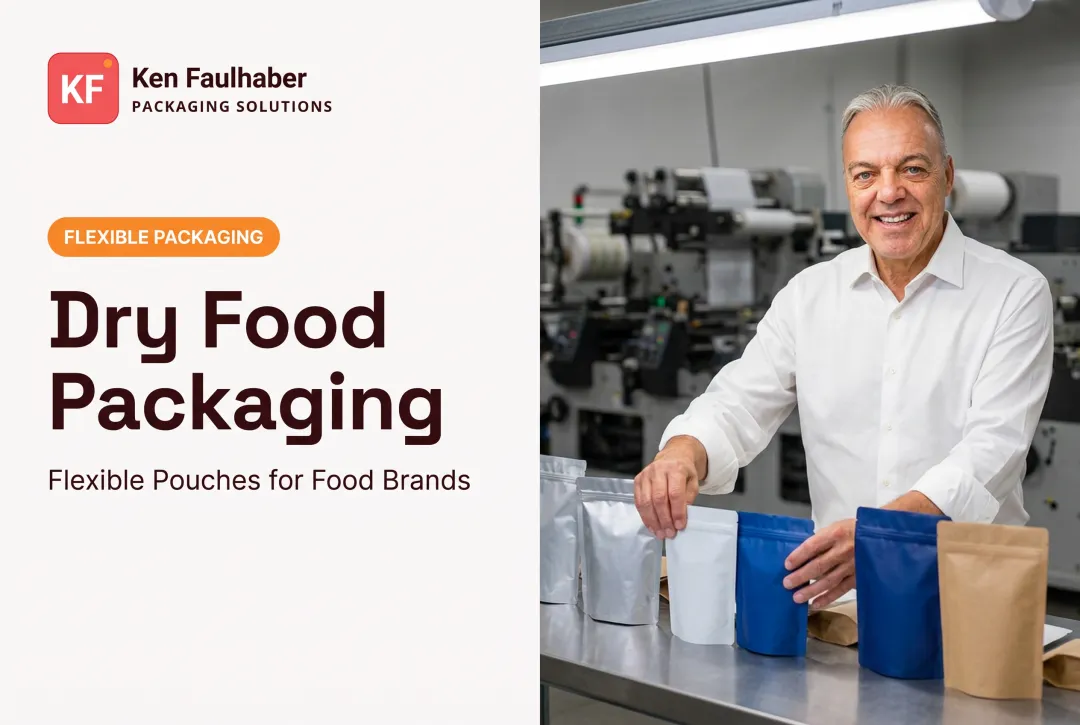
Juggling separate vendors for pouches, trays, and shrink sleeves multiplies handoffs and delays. Ken Faulhaber Packaging Solutions gives brands one point of contact instead.
As an independent representative connecting food, beverage, and meat/poultry brands with Formosa's manufacturing network, Ken routes projects directly to Formosa's in-house capabilities:
- Plastic thermoforming for trays, blister packs, and clamshells
- Custom pouches, gusset bags, and shrink sleeves through the RBD umbrella brand
- Five-layer high-speed lamination, tuned to your specific WVTR and OTR requirements
- In-house bag making under one roof, with zero handoff between process steps
Instead of coordinating three vendors for one product launch, you describe your product, target format, quantity, and barrier needs once. Ken typically responds within one business day and matches the project to the right capability.

Certifications to Look For
When vetting any packaging supplier, check for:
- ISO 9001:2015 — quality management systems
- ISO 22000:2018 — food safety management
- FSSC 22000 — food safety certification scheme
- HACCP compliance — hazard analysis and preventive controls
A certificate alone doesn't guarantee your label is compliant, but it signals the supplier has documented quality and food-safety systems in place. Before committing, request samples and review barrier test data against your product's real shelf-life conditions.
Where Can I Find Labels for Ingredients?
Ingredient statements for food appear on the information panel of packaging, typically below or near the Nutrition Facts panel. Cosmetic and over-the-counter drug labeling follow different rules entirely.
For compliant naming and formatting, start with these primary sources:
- FDA Food Labeling Guide
- eCFR Title 21, Part 101 (the controlling regulation)
- FDA's Food Allergies page for current allergen lists
Label converters and packaging suppliers often provide pre-press and design support as well. They can confirm your ingredient statement meets type-size and placement rules before print—catching costly mistakes before they reach thousands of units.
How to Find and Vet Ingredient and Packaging Suppliers
Finding a reliable supplier takes real legwork, not just a Google search.
- Research online first. Check reviews, ask for references, and look at how long they've operated in the space.
- Talk to them directly. A phone call reveals more about reliability and communication style than any website.
- Request samples. Compare quality across at least two or three suppliers before committing.
- Get multiple quotes. Pricing varies more than most new brands expect.
- Verify food-safety credentials. Confirm certifications such as HACCP, ISO 22000, or FSSC 22000 before you move forward.
- Set clear expectations upfront. Document quality standards, timelines, and pricing terms before you sign anything.
A supplier relationship built on clear communication from the start tends to hold up better when something inevitably needs adjusting mid-production.
Frequently Asked Questions
What are the FDA ingredient list requirements?
Ingredients must be listed in descending order by weight on the information panel, with major allergens declared parenthetically or in a "Contains" statement. Packages must also carry the manufacturer name, net quantity of contents, and a Nutrition Facts panel.
What are the 7 types of packaging?
The main categories are flexible packaging, rigid/thermoformed plastics, shrink sleeves and labels, paperboard cartons, glass and metal, sustainable/compostable formats, and vacuum-sealed/modified atmosphere packaging.
Where can I find labels for ingredients?
Ingredient lists typically appear near the Nutrition Facts panel on food packaging. The FDA Food Labeling Guide and eCFR Title 21 are the primary references, and packaging suppliers can help with compliant label design.
What is the difference between an ingredient label and a marketing label?
An ingredient label is federally mandated and must be accurate, following strict FDA formatting rules. A marketing label is promotional copy on the package and faces far less regulatory scrutiny.
How do I choose the right packaging material for my food product?
Base your decision on barrier requirements (WVTR/OTR), shelf-life goals, and production volume. A high-moisture product needs different protection than a shelf-stable dry good.
How long does it take to source a new packaging supplier?
Timelines vary with format complexity and certification needs. An integrated single-representative model, such as Ken Faulhaber Packaging Solutions' access to Formosa's manufacturing network, can shorten sourcing because one contact coordinates the full process.